Thursday, May 14, 2020
Tensile Bubbles and Platonic Geometric Solids
Have you heard of Platonic Geometric Solids? What about Tensile Structures? I had not heard of either. You can teach both concepts with Tensile Bubbles. First, let your kids test Super Bubble Recipes. Which dish detergent makes the longest lasting bubbles? Is glycerine better than corn syrup? Make and identify the geometric solids. Test drinking straws and plastic coffee stirrers. Tray making pipe cleaner shapes. Gather your shapes and bubble mix and have a blast outside. Don’t forget to take photos to add to your digital portfolio. Get going!

LeapPad
Are you interested in LeapPad or LeadFrog? Good Will has several listings: LeapFrog Schoolhouse, LeapFog Backpack, and Older versions. I am biased toward iPads for education; however, kids like any form of technology. If you have a young child or reluctant reader, LeapPad may appeal to her. Once you buy a LeapFrog device, buy up compatible software and books—just as you would if you had bought an older game system.
Tuesday, May 12, 2020
What are you doing this summer?
First, our household plans to school all summer. Paul, nine, has been out of public school for two months. I teach science. If you want ideas about science camp at home see my science blog. Recently, I have several posts with fun activities.
Right now, Paul does my curriculum and Choice Boards from his elementary school. He does about 1 1/2 hours of math, 45 minutes of science, 45 minutes of history, and 45 minutes of English. After lunch is an hour outside, followed by an hour of Choice Boards, 30 minutes of guitar, 45 minutes of Lego, reading, and more outside play.
This summer we are following the morning routine with four subjects: math, science, history, and English. After lunch, school is out and camp is in! Already we are doing fun science activities or labs twice a week, such as making Cartesian divers and Tornado in a Bottle. Paul is finishing Zoology 1. We plan to use Chemistry and Physics for science in the mornings, with fun labs and projects in the afternoon, such as diy super balls, slime, periodic table cookies, etc. My husband and I teach Physics and Chemistry—we have ideas!
We hope the pool opens; camps and VBS are closed this summer. We plan to strike out on our own. It won’t all be school or camp. We planted seeds for a garden, are working on Cub Scout badges, have cooking lessons, make cartoons, and have stacks of kits in the basement to build. But this summer, school is on and structured around three solid hours of Math, Science, History, and English.
Right now, Paul does my curriculum and Choice Boards from his elementary school. He does about 1 1/2 hours of math, 45 minutes of science, 45 minutes of history, and 45 minutes of English. After lunch is an hour outside, followed by an hour of Choice Boards, 30 minutes of guitar, 45 minutes of Lego, reading, and more outside play.
This summer we are following the morning routine with four subjects: math, science, history, and English. After lunch, school is out and camp is in! Already we are doing fun science activities or labs twice a week, such as making Cartesian divers and Tornado in a Bottle. Paul is finishing Zoology 1. We plan to use Chemistry and Physics for science in the mornings, with fun labs and projects in the afternoon, such as diy super balls, slime, periodic table cookies, etc. My husband and I teach Physics and Chemistry—we have ideas!
We hope the pool opens; camps and VBS are closed this summer. We plan to strike out on our own. It won’t all be school or camp. We planted seeds for a garden, are working on Cub Scout badges, have cooking lessons, make cartoons, and have stacks of kits in the basement to build. But this summer, school is on and structured around three solid hours of Math, Science, History, and English.
How do you deal with proposed intermittent school closings?
Next fall, some schools may be on staggered schedules, hybrid classes, and intermittent school closings? Are you feeling panicked? Don’t! Start a plan today. Our small household is planning to school all summer. Right now, the nine year old, Paul, works on school for about four hours each day. There is plenty of time for bike riding, guitar practice, reading, and Legos. This summer, our plan is to school for three hours in the morning and have camp with fun activities in the afternoons. Why? Paul is enrolled in public school. He has already missed two months of school. The work assigned from his elementary teacher consists of Choice Boards. These activities take about one hour each day. Paul is studying Zoology 1, Saxon 5/4 Math, History, Easy Grammar, Vocabulary, Handwriting, and Reading: Mud Shark, Holes, and Wrinkle in Time. Paul has an English anthology, a host of history books, dictionaries, etc. School continues over the summer. We are using this time to develop research papers, learn how to make a slide show, understand how to use a dictionary, manipulate a digital microscope, create timelines, and life cycles, practice hand-writing, improve his math, etc. Let’s get to work and use this time to get ahead, not tread water!
Tuesday, May 5, 2020
Google Suite
I like tech which supports education—not supplants education. Digital Choice Boards may or may not support rigorous education. You decide. Here is an example for high school and here are elementary examples. I want content not gimmicks.
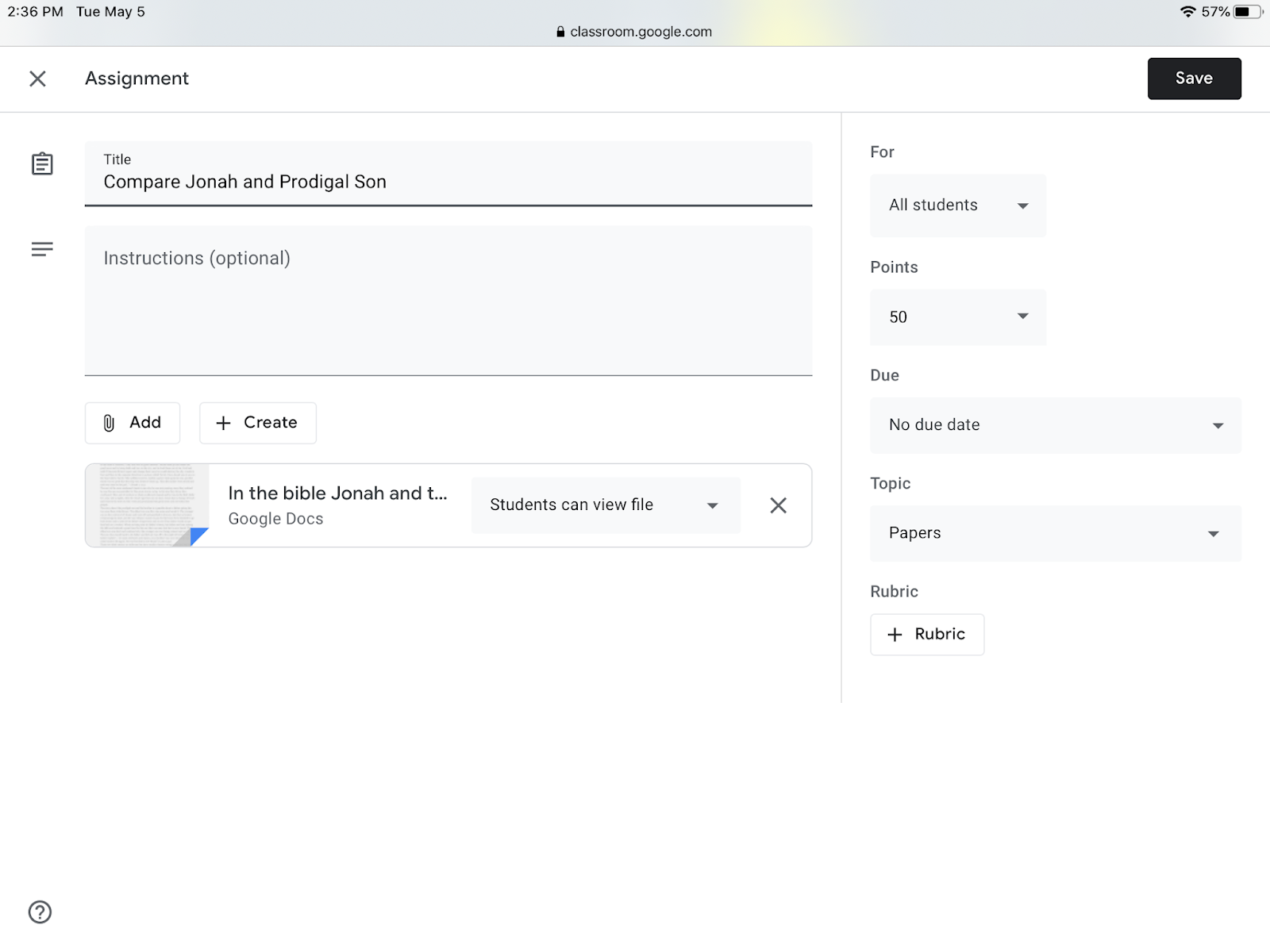
I love to use tech to teach. Right now my Co-op class is working remotely. I maintain a blog with notes about assignments. Additionally, I am video-taping lessons on YouTube. Blogger and you-tube are part of Google Suite. If you have a gmail account, you have free access to Drive storage, Docs, Sheets, and Slides. Another resource, Google Classroom, is a phenomenal tool. Originally, I used Classroom for grades. Gradually, I posted assignments and links for kids to make up missed class work. Now that I am teaching remotely, I organized lessons into blocks with videos, worksheets, labs, and tutorials. You can use Classroom to make homework assignments. I use Classroom as a digital portfolio, too. I try to copy essay documents or photos of quizzes and work as links and post them with the assignment and grade on Classroom. This makes it much easier to organize a digital portfolio to submit to an online school. Take a look.


I love to use tech to teach. Right now my Co-op class is working remotely. I maintain a blog with notes about assignments. Additionally, I am video-taping lessons on YouTube. Blogger and you-tube are part of Google Suite. If you have a gmail account, you have free access to Drive storage, Docs, Sheets, and Slides. Another resource, Google Classroom, is a phenomenal tool. Originally, I used Classroom for grades. Gradually, I posted assignments and links for kids to make up missed class work. Now that I am teaching remotely, I organized lessons into blocks with videos, worksheets, labs, and tutorials. You can use Classroom to make homework assignments. I use Classroom as a digital portfolio, too. I try to copy essay documents or photos of quizzes and work as links and post them with the assignment and grade on Classroom. This makes it much easier to organize a digital portfolio to submit to an online school. Take a look.

Go back to basics!
Have you heard of Choice Boards? Many school systems are using them to teach remotely. The advantage is work can be organized into a calendar of daily activities. I am not a fan. I want more depth and content. Teachers have a habit of spiking the boards with fun or silly activities such as jokes. Let’s teach three hours daily of math, science, history, and English: grammar, literature, vocabulary, hand-writing, and composition. Is a disparate assortment of daily activities going to substitute for meaningful work? Nope. Why do I use textbooks? They are consistently organized to deliver a complete, coherent curriculum. Choice Boards are like Summer Bridge Activity books; they are better than nothing. However, they do not replace a dedicated curriculum.
Still toughing things out!
Our little household is plugging away. I have noticed a bias: we spend almost two hours each day on math. Happily, the other subjects are more balanced. Our nine year old grandson, Paul, has been home-schooled for the first time the past two months. Paul is enrolled in a local public school. Three weeks elapsed before the teachers implemented Digital Choice Boards. I am not a fan. The content is varied; however, the amount of work is scant. I want solid core instruction.
What is Paul doing? He does about two hours of math, 45 minutes of science, Zoology 1, 30-45 minutes of History, and 30-45 minutes of Language Arts: Reading, Grammar, Hand-writing, Vocabulary, and Composition. Usually, Paul spends about three hours on work for us. After lunch and a long bike ride, Paul works for an hour on the Choice Board for the public school. Then, he spends 30 minutes practicing guitar and an hour programming Lego Boost. It’s a full day.
What is Paul doing? He does about two hours of math, 45 minutes of science, Zoology 1, 30-45 minutes of History, and 30-45 minutes of Language Arts: Reading, Grammar, Hand-writing, Vocabulary, and Composition. Usually, Paul spends about three hours on work for us. After lunch and a long bike ride, Paul works for an hour on the Choice Board for the public school. Then, he spends 30 minutes practicing guitar and an hour programming Lego Boost. It’s a full day.
Subscribe to:
Posts (Atom)